

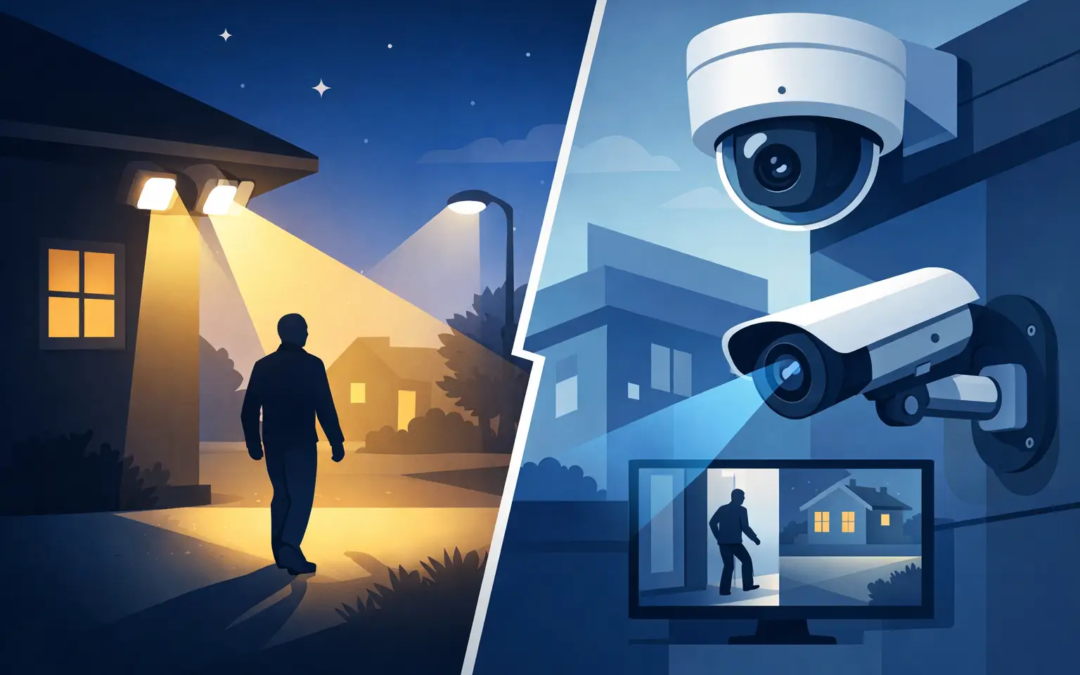
A dark side entrance, an unlit parking area, and a camera mounted too high to identify a face can all create the same problem: a property that is harder to protect. When comparing security lighting versus surveillance cameras, the best choice is rarely an either-or decision. Each handles a different part of the job. Lighting can discourage unwanted activity and help people see what is happening. Cameras can document activity, send alerts, and provide a record when something goes wrong.
For homeowners and small business owners, the practical question is not which product sounds more advanced. It is where the risk is, what you need to know, and how much visibility you need after dark.
Security Lighting Versus Surveillance Cameras: The Core Difference
Security lighting is mainly a visible deterrent and a safety tool. A well-placed light removes the cover of darkness around doors, driveways, walkways, loading areas, and other vulnerable spots. Motion-activated lights can also signal that someone has entered an area where they should not be.
Surveillance cameras are primarily monitoring and evidence tools. They let you check activity in real time or review recorded footage later. Depending on the system, a camera may send a notification when a person, vehicle, or motion is detected. That can help you respond quickly, verify a delivery, check on a vacant property, or share useful footage after an incident.
Neither option guarantees that a crime will not occur. Good security reduces opportunity, improves awareness, and makes a property less appealing as an easy target. The strongest setup often uses both tools in the places where they make sense.
When Security Lighting Is the Better First Step
Lighting is often the right first investment when the problem is simple: people cannot see the property clearly at night. This is common around rear doors, side gates, detached garages, dumpsters, shared walkways, and small-business entrances after closing.
A bright, reliable light can make someone think twice about lingering near a door or trying to move unnoticed. It also helps residents, employees, and customers avoid trips and falls. For a rental property, good exterior lighting can make tenants feel safer when arriving home after dark without requiring them to learn a new app or monitor camera alerts.
Motion-activated lighting is useful for areas that do not need to stay illuminated all night. The sudden light draws attention to movement and can be less disruptive to neighbors than leaving a high-powered floodlight on continuously. Dusk-to-dawn lighting, on the other hand, is useful for entrances, address numbers, and pathways where consistent visibility matters.
Lighting has limits. It does not tell you who was outside, where they went, or what happened after they left the illuminated area. It can also create glare if installed poorly. A light aimed directly at a camera lens, a neighbor’s window, or a driver’s line of sight may cause more problems than it solves.
When Cameras Provide More Value
Cameras are a better starting point when you need answers, not just illumination. A small business owner may want to confirm who accessed a back door. A homeowner may want to know whether a notification was a package delivery, a lost pet, or someone checking vehicles in the driveway. A property manager may need a record of recurring activity near a common entrance.
A camera can provide that context. It can also help you avoid reacting to rumors or incomplete information. Instead of wondering whether a gate was left open or a person was on the property, you can review what the camera captured.
Placement matters more than the number of cameras. One camera at a primary entry, pointed at the approach rather than only the doorstep, may be more useful than several cameras covering low-risk areas. For a small storefront, coverage of the front entrance, register area, and rear access point usually has more value than wide views of empty walls or distant parking spaces.
Cameras also require some ongoing attention. You need a stable power source, a dependable connection if you want remote access, and a plan for storage or recording. Lenses need occasional cleaning. Settings should be checked so alerts are helpful rather than constant. If a camera produces dozens of notifications from passing cars or moving tree branches, people eventually stop paying attention.
The Nighttime Factor: Cameras Still Need Light
Many cameras include night vision, but that does not mean lighting is unnecessary. Night vision can show movement in low light, yet image detail may be limited. Faces, clothing colors, license plates, and activity farther from the camera can be harder to identify than they are in a well-lit area.
This is where lighting and cameras work especially well together. A motion light can improve the view when someone approaches a door, gate, or driveway. A camera can then record clearer footage and notify you about the event. The key is to avoid placing a bright fixture directly in front of the camera or pointing it into the lens, which can wash out the image.
For best results, light the area a person will walk through, not the camera itself. Test the view after dark before treating the installation as finished.
Cost, Privacy, and Day-to-Day Use
Security lighting is usually less expensive to buy and maintain than a multi-camera system. It is simple to operate, and there may be no subscription, storage plan, or mobile app involved. That makes it a practical choice for a tight budget or a location where basic visibility is the main need.
Cameras can cost more, especially when professional installation, cloud recording, or several coverage areas are involved. In return, they offer information that lighting cannot provide. For many property owners, that added awareness is worth the investment at key entry points.
Privacy deserves consideration as well. Cameras should be aimed at your own entrances, parking areas, and property boundaries. Avoid pointing them into neighbors’ windows, private yards, or places where people reasonably expect privacy. Businesses should make employees aware of camera use and follow applicable state and local requirements.
There is also a practical difference in how each system feels to use. Lighting works in the background. Cameras ask more of you because alerts, footage, passwords, and occasional maintenance need attention. A simple system that you will actually check is better than a complicated one that gets ignored.
A Simple Way to Choose
Start with the specific concern rather than the product. If your main concern is walking safely to the front door, seeing the side yard, or making a rear entrance less inviting after dark, lighting may solve the immediate problem. If you need to verify activity, monitor access, or keep a record of events, cameras are likely the better fit.
Use these four questions to narrow the decision:
- Is the area too dark for residents, employees, or visitors to move safely?
- Do you need to know who entered the area and when?
- Would better nighttime image quality matter if an incident occurred?
- Is this a high-priority entry point, or simply a place that needs better visibility?
If the answer is yes to both visibility and documentation, combine the two. Put a motion light near the approach and a camera where it can capture a clear view of faces, vehicles, or entry activity. For many homes, that means the front door, driveway, and a less visible side or rear door. For small businesses, it often means customer entrances, employee doors, rear access, and any area where equipment or inventory is stored.
Avoid Common Installation Mistakes
The most common mistake is treating security equipment as decoration. A light above a door may look useful but leave the approach in shadow. A camera may be visible but aimed so wide that it cannot capture usable detail. Before installing anything, walk the property at night and think through how a person would approach it.
Keep cameras at a height that discourages tampering while still allowing a useful angle. Make sure exterior lights are weather-rated and positioned to reduce glare. Trim shrubs or branches that block a camera’s view or create false motion alerts. If your property has more than one person using the system, make sure they know how to receive alerts, view footage, and report a problem.
Security does not have to be complicated to be effective. A few well-chosen lights and cameras, placed around the areas that matter most, can provide clearer visibility, better awareness, and more confidence when the property is unattended.