

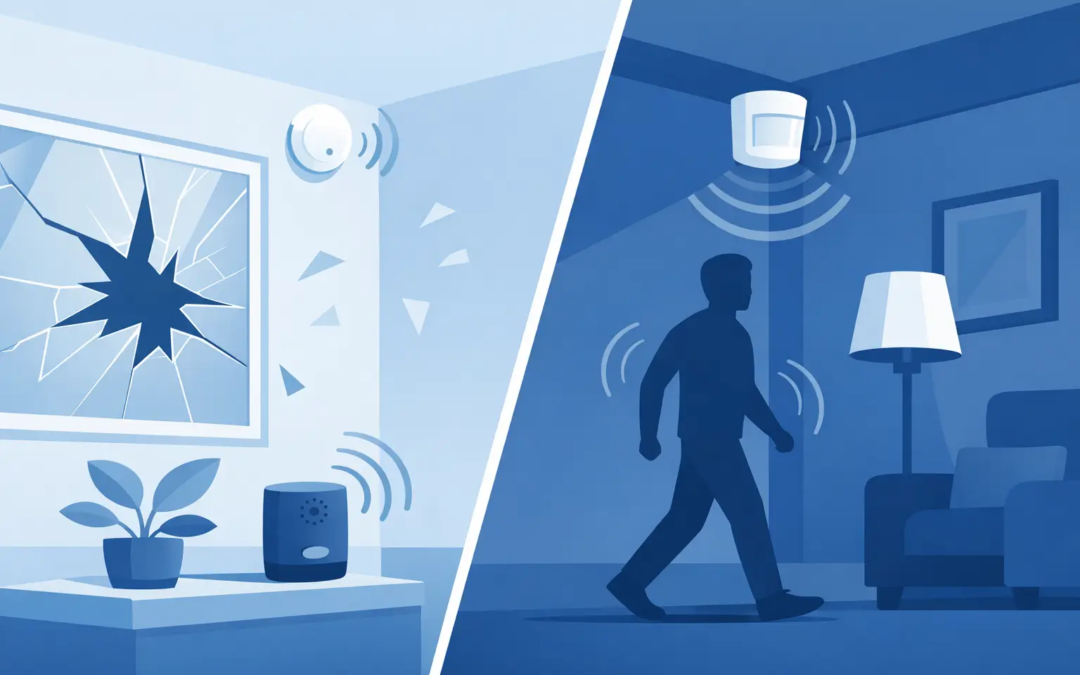
A broken window can be an intruder’s fastest way in, but movement inside a room is often the next clear sign that something is wrong. That is why the choice between a glass break sensor vs motion detector is not really about picking the “better” device. It is about matching detection to the way someone could enter and move through your property.
For many homes and small businesses, the practical answer is to use both in the places where they make sense. Still, understanding what each device does helps you avoid paying for equipment that does not solve the risk you actually have.
Glass Break Sensor vs Motion Detector: The Basic Difference
A glass break sensor listens for the sound pattern created when glass breaks. Depending on the model, it may recognize the low-frequency impact of an object striking a window followed by the higher-frequency sound of shattering glass. When it detects that pattern, it sends an alarm signal.
A motion detector works differently. It watches for movement within a designated area, usually by sensing changes in heat or infrared energy. If someone walks through the protected space while the system is armed, the detector can trigger an alarm.
Put simply, a glass break sensor is focused on a possible point of entry. A motion detector is focused on activity after someone is inside. One can alert you at the window. The other can alert you in the room, hallway, or open area beyond it.
When a Glass Break Sensor Makes Sense
Glass break sensors are most useful where windows or glass doors create a realistic entry risk. A burglar may break glass to reach a lock, open a door, or climb through a window without opening it first. Standard door and window contacts may not trigger in that situation because the window or door itself was never opened.
They can be a smart addition in living rooms with large windows, rooms with sliding glass doors, sunrooms, and ground-floor spaces that face a street, side yard, or less visible area. For a small business, they are often useful near storefront windows, glass entry doors, and offices with accessible exterior windows.
Placement matters. Most acoustic glass break sensors are designed to cover a specific range, often a single room or an open connected area. They need to be mounted where they can clearly pick up the sound of breaking glass. Heavy curtains, thick walls, and doors between the sensor and the glass can reduce coverage. A technician can help confirm whether one sensor covers the room or whether separate areas need their own protection.
Glass break sensors are not meant to detect every loud sound. A quality device is designed to reduce false alarms from normal household noise. Even so, it should be tested after installation using the approved method for that model. Do not assume that a sensor will protect windows in another room just because they are nearby.
What glass break sensors do not cover
A glass break sensor does not protect a window that is quietly opened or a door that is forced without breaking glass. It also does not tell you whether someone moves deeper into the property after entering through another route. That is where door and window contacts, motion detectors, or both come in.
When a Motion Detector Makes Sense
Motion detectors are useful for covering larger interior areas with fewer devices. A properly placed detector can watch a living room, open floor plan, hallway, basement, stockroom, or office area. Instead of placing a sensor on every possible path through a space, you can often protect the main route an intruder would need to use.
For homeowners, motion detection is especially helpful in rooms with multiple entry points or areas where a person is likely to pass through after entering. A detector at the end of a hallway can cover access to bedrooms. One in a main living area can add a second layer of protection behind exterior doors and windows.
For small businesses, motion detectors are often a practical way to protect open sales floors, back rooms, and workspaces after closing. They are also valuable when a building has many interior routes that would be difficult to cover with contacts alone.
The main consideration is how the space is used while the system is armed. If people, employees, pets, or cleaning crews are expected to move through the area, the detector may need to be bypassed, set to a different arming mode, or placed elsewhere. Many modern detectors offer pet-friendly settings, but no device is completely immune to false alarms if a large pet climbs onto furniture or moves close to the sensor.
Placement is more important than quantity
Motion detectors work best when they are positioned to see movement across their field of view rather than directly toward them. Corners of rooms are common mounting locations because they provide a wider view. They should not be aimed at heat sources, direct sunlight, moving curtains, or HVAC vents that may affect performance.
A single poorly placed motion detector can leave a major blind spot. A smaller number of well-placed devices is usually better than filling every room with sensors you do not need.
Which One Is Better for Your Property?
The right choice depends on the property and the security gap you want to close.
Choose a glass break sensor when the biggest concern is an intruder breaking a window or glass door to get inside. It is particularly useful if you have large panes of glass, sliding doors, or a storefront with exposed windows.
Choose a motion detector when you need to protect a broad indoor area or confirm movement after entry. It is often the more cost-effective option for covering a large room, hallway, or open business space.
If you are deciding between the two because you can only add one device right now, look at the most likely entry route. A home with several accessible sliding glass doors may benefit more from glass break detection. A small office with a solid front door but a large interior floor plan may benefit more from motion coverage.
Neither device replaces basic perimeter protection. Door and window contacts remain useful because they alert you when a protected opening is opened. Cameras can provide visual information, while monitored alarms can help ensure an alert receives attention when you cannot respond yourself. Each component has a different job.
Why Using Both Often Provides Better Coverage
Using a glass break sensor and a motion detector together creates layered protection. If someone breaks a window, the glass break sensor can alert the system immediately. If an intruder enters another way or continues moving through the property, the motion detector adds another chance to catch that activity.
This approach is useful because real break-ins do not follow one predictable pattern. An intruder may force a door, pry open a window, break glass, or take advantage of an unlocked access point. Layered security helps account for those different possibilities without making your system unnecessarily complicated.
For example, a ground-floor living room with a sliding glass door may need a glass break sensor because the door can be shattered without opening. A motion detector aimed across the living room or toward the hallway adds protection if someone enters and moves farther into the home. The same setup can work for a small retail space with a glass storefront and an open sales floor.
Practical Questions Before You Decide
Start with a simple walk around your property. Which doors and windows are accessible from outside? Are there large glass doors or storefront windows? Which rooms would an intruder likely cross after getting in? The answers will point to the devices that deserve priority.
Also consider daily life. Do you have pets that roam while the system is armed? Does a business have staff who work late? Are some areas regularly occupied while others need protection overnight? A security system should fit the way the property is actually used, not force you into routines that are difficult to maintain.
It is also worth thinking about alarm modes. Many systems let you arm perimeter devices while people are home, then arm interior motion detection when everyone leaves. That setup allows glass break sensors and door contacts to stay active overnight without triggering an alarm when someone walks to the kitchen.
A clear security plan does not require complicated equipment. It requires the right devices in the right places. Whether you start with a glass break sensor, a motion detector, or a combination of both, focus on the entry points and interior spaces that matter most to your peace of mind.