

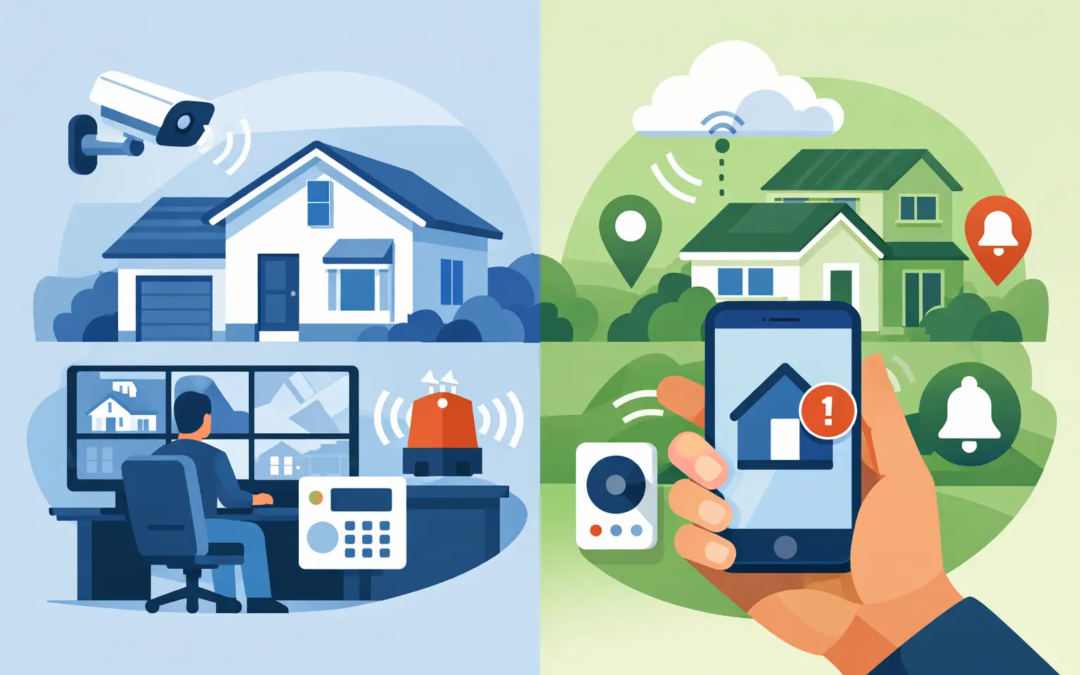
A security alert at 2:00 a.m. is only useful if someone can act on it. That is the real question behind local monitoring versus mobile alerts. One option keeps the response close to the property. The other puts information in your pocket wherever you are. For many homes and small businesses, the best choice is not about choosing the newest feature. It is about choosing a system that fits who is available, how quickly they can respond, and what needs protection.
What Local Monitoring Means
Local monitoring generally means security activity is handled at or near the property. A system may sound a siren, display activity on a control panel, trigger lights, or record video to equipment located on-site. The people most likely to notice and respond are those inside the home or business, nearby staff, neighbors, or a designated contact.
For example, a door sensor may trigger a loud alarm when a protected entry is opened. A camera may save footage locally for later review. At a small storefront, an employee might see an alert on a panel and check the building before opening. The system is doing its job locally, without requiring someone to be watching an app every moment of the day.
This approach can be simple and dependable for properties that are regularly occupied. A loud siren can discourage an intruder, draw attention, and tell everyone inside that something needs attention. Local recording can also preserve video even when internet service is interrupted, depending on the equipment and its power source.
But local monitoring has a clear limitation: someone needs to be close enough to hear, see, or respond to the event. If a family is away for the weekend or a business is closed overnight, an on-site alarm may still sound, but there may be no one nearby to take the next step.
How Mobile Alerts Work
Mobile alerts send security notifications through an app, text message, email, or push notification. When a sensor is triggered, a camera detects motion, or a door is opened, the system sends information to a smartphone or other connected device.
The main benefit is visibility from a distance. A homeowner at work can see that a package was delivered. A property manager can receive notice that a vacant unit door opened. A small business owner can check a camera after an after-hours motion alert.
Mobile alerts are especially useful for people who are not at their property all day. They can make it easier to check on pets, children arriving home from school, employees opening a business, or deliveries at an entrance. They also create a record of activity that can help owners spot patterns, such as repeated late-night motion near a side door.
Still, a phone notification is not the same as an active response. It can be missed while you are driving, in a meeting, asleep, in an area with poor cell service, or simply away from your phone. If an alert reaches you when you are 100 miles away, you may be able to view a camera feed, call a neighbor, or contact local authorities if appropriate, but you cannot physically check the property yourself.
Local Monitoring Versus Mobile Alerts: The Key Difference
The simplest way to compare local monitoring versus mobile alerts is this: local monitoring focuses on what happens at the property, while mobile alerts focus on keeping you informed wherever you are.
A local siren creates an immediate on-site signal. A mobile alert gives you awareness and the chance to decide what to do next. Neither option automatically replaces the other. In fact, many practical security setups use both.
Consider a homeowner whose back door opens unexpectedly at night. A local alarm can wake the household and make the event obvious to anyone nearby. A mobile alert can notify a spouse who is traveling or an adult child who helps check on the home. The first feature creates immediate attention at the property. The second extends awareness beyond it.
For a small business, the same combination can be useful. A siren or visible alarm may help deter unwanted entry, while a mobile notification allows the owner to review activity from home. The right setup depends on the building, operating hours, neighborhood, and the value of what is inside.
Where Each Option Can Fall Short
Security works best when its limits are understood ahead of time. Local-only systems can be less useful when a property is empty for long periods. A siren may attract attention, but it does not guarantee that a neighbor will investigate or that the owner will know what happened right away.
Mobile-only systems have different weak points. They depend on reliable communication, a charged phone, correct app settings, and a person who can make a good decision under pressure. Too many motion notifications can also create alert fatigue. If a camera sends repeated notices for passing cars, tree branches, or normal employee movement, users may start ignoring alerts that matter.
Internet and power outages should also be part of the conversation. Some systems have battery backup, cellular communication, local storage, or other protections that help maintain key functions during an outage. Others may lose remote access when the network goes down. The details matter, so ask how a system behaves if power, Wi-Fi, or cellular service is unavailable.
When Local Monitoring May Be Enough
Local monitoring can be a sensible fit for an occupied home, a small office with regular staff, or a property where immediate on-site awareness is the main goal. It may also appeal to customers who want a straightforward system without relying heavily on apps and remote controls.
It is often most useful when people are usually present, neighbors are close by, and the system includes clear deterrents such as entry sensors, lighting, cameras, and an audible alarm. A local setup can also be a good foundation for someone who wants to start with basic protection and add remote features later.
The question to ask is not, “Will an alarm stop every problem?” No security system can promise that. A better question is, “If something happens here, will the people who need to know be likely to notice quickly?”
When Mobile Alerts Make More Sense
Mobile alerts are a strong choice for people who spend significant time away from the property. That includes commuters, frequent travelers, landlords, vacation-home owners, and business owners who cannot be on-site after closing.
They are also helpful when the goal is not only intrusion detection. Door, window, leak, temperature, and camera alerts can provide useful information before a small issue becomes a larger one. A notification about an open storage-room door or a water sensor activation gives an owner a chance to check the situation promptly.
To make mobile alerts useful, keep them focused. Set motion zones carefully, choose which events truly need immediate attention, and make sure more than one trusted person can receive critical notifications when appropriate. Test alerts after installation, including what happens when the phone is locked, on silent mode, or temporarily disconnected from Wi-Fi.
Professional Monitoring Is a Separate Decision
Local monitoring and mobile alerts are often discussed alongside professional monitoring, but they are not the same thing. Professional monitoring involves a trained monitoring center receiving qualifying alarm signals and following an agreed response process. Depending on the service and event, that may include attempting to contact designated people or requesting emergency dispatch.
For some households and businesses, professional monitoring adds confidence because there is another layer of response when they cannot answer a phone. For others, local alerts and mobile notifications may be enough based on budget, daily routines, and risk level.
This is not an all-or-nothing choice. A property can have a local alarm, mobile alerts, and professional monitoring together. Or it can use only the features that solve its most immediate concerns. The best arrangement is the one people understand, maintain, and use consistently.
Choose Based on Your Real Routine
Before selecting equipment or service, think through a normal week. Who is at the property during the day? Who is there overnight? How often is the building empty? Who can respond if an alert comes in? Are there reliable neighbors, employees, or property contacts nearby?
Also consider the risks that concern you most. A family may prioritize doors, windows, and driveway activity. A small business may focus on after-hours entry, cash areas, inventory rooms, and employee access. A rental property may need better visibility between tenants. The answers should guide the system, not the other way around.
Simple Security Solutions encourages customers to start with clear questions rather than complicated packages. A security system should make it easier to know what is happening at your property and what to do next.
The most helpful choice is usually the one that gives you timely awareness without creating confusion or constant noise. Whether that means a local alarm, mobile alerts, professional monitoring, or a combination, choose a setup that still makes sense when life gets busy and you need it most.