

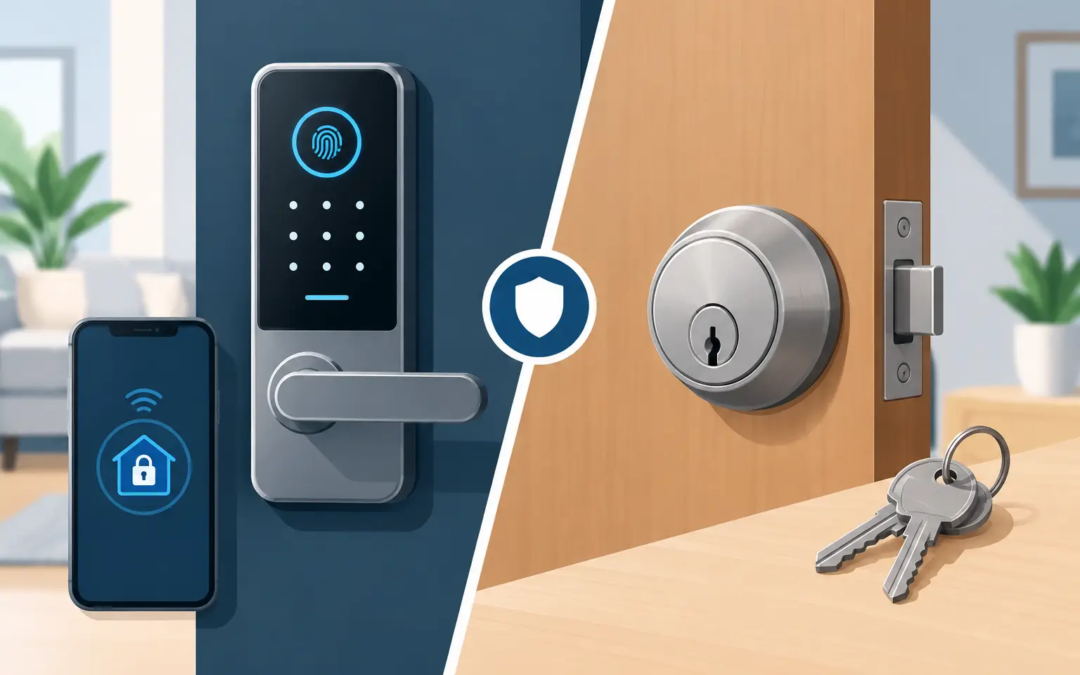
A lock is one of the first decisions people make when protecting a home, rental, office, or storefront. Yet smart locks versus traditional locks is not a simple question of new technology beating an old key. The better choice depends on who needs access, how often that access changes, what happens during a power or Wi-Fi outage, and how much hands-on management you want.
For many properties, a standard deadbolt remains a dependable, affordable answer. For others, the ability to issue a temporary code, check lock activity, or avoid copying keys solves everyday problems. The goal is not to buy the most complicated lock. It is to choose one that makes your property easier to secure.
How Traditional Locks Work in Real Life
Traditional locks use a physical key and a mechanical cylinder. A quality deadbolt has few moving parts, does not depend on batteries or an internet connection, and is familiar to nearly everyone who uses it. If the lock is properly installed in a solid door with a reinforced strike plate, it can provide reliable day-to-day protection.
That simplicity is the main advantage. There is no app to set up, no code to remember, and no concern about a battery running low. Traditional locks also tend to cost less upfront, both for the hardware and installation. For a homeowner who rarely gives access to other people, or a small business with a stable group of keyholders, that may be all that is needed.
The downside appears when keys change hands. A lost key may create uncertainty, even if it was labeled with nothing more than a house number. If a tenant, contractor, former employee, or neighbor has a key that is not returned, the safest response is often to rekey or replace the lock. Copies can also be made without the property owner’s knowledge.
Where Smart Locks Add Value
Smart locks replace or supplement a physical key with a keypad, phone app, fob, fingerprint reader, or connected access system. Many models still include a key cylinder as a backup. Their practical benefit is control over access without having to meet someone at the door or distribute another metal key.
A homeowner can create a code for a dog walker and remove it when the arrangement ends. A landlord can change access between tenants without collecting every spare key. A small business owner can give staff individual codes instead of relying on one shared key. Depending on the lock and setup, activity alerts or access logs can show when a door was opened and by which code.
These features are useful when they solve a real access problem. A smart lock is not automatically more secure simply because it connects to an app. Its value comes from reducing key-sharing, making permissions easier to manage, and helping the responsible person stay informed.
Convenience Does Not Mean No Maintenance
Smart locks need regular attention. Most are battery powered, so batteries must be replaced on schedule. The lock may warn you through an app, keypad, or low-battery indicator, but it is better not to wait for the warning before keeping fresh batteries available.
Some features also rely on Bluetooth, Wi-Fi, a hub, or a subscription service. That can affect remote control, notifications, and activity history. Before choosing a model, confirm what still works at the door if the internet is down. In many cases, local keypad entry will continue to work while remote features do not.
For a rental or business, it is also worth assigning a clear person to manage codes, user permissions, and battery changes. A smart lock is easiest to live with when access management is treated as a simple routine rather than an occasional task.
Smart Locks Versus Traditional Locks: Key Differences
The decision usually comes down to four areas: access, reliability, cost, and fit for the property.
Access management: Traditional locks are straightforward but require physical key control. Smart locks make it easier to add, remove, and limit access. This matters most for properties with cleaners, caregivers, service providers, tenants, employees, or frequent visitors.
Reliability: A mechanical deadbolt works without power, software, or a connection. A smart lock adds electronics and requires battery maintenance, although most reputable options include backup entry methods. For an exterior door, choose a lock with a dependable manual key override or another clearly understood backup plan.
Cost: A traditional deadbolt is generally less expensive to purchase and maintain. Smart locks cost more upfront and may require a compatible hub, professional setup, or occasional replacement batteries. The added expense can be worthwhile when it prevents repeated rekeying or saves time managing access.
Visibility and control: With a traditional lock, you may not know whether someone used a copied key. With a smart lock, you may be able to see access activity and revoke a code quickly. That added oversight can be especially helpful for a small office, short-term rental, or property managed from a distance.
Security Depends on More Than the Lock
Whether you choose smart or traditional hardware, the door itself matters just as much. A strong deadbolt cannot compensate for a weak door frame, loose strike plate, short screws, or a glass panel placed within easy reach of the interior thumb turn.
Start with solid installation. Exterior deadbolts should be mounted correctly, and strike plates should be secured with long screws that reach the framing behind the door jamb. Make sure the door closes and latches smoothly. A lock that binds because the door is misaligned may frustrate users and wear out faster.
For connected locks, basic digital habits matter too. Use a strong, unique password for the account connected to the lock, turn on multi-factor authentication when it is offered, and keep the lock app and device firmware updated. Do not share one common code with everyone. Individual codes make it much easier to remove access when circumstances change.
A smart lock should not be your only security measure. Good exterior lighting, working door and window locks, an alarm system when appropriate, and clear procedures for keys and codes all work together. The same is true for a traditional lock. Physical security is strongest when each layer supports the others.
Which Lock Fits Your Property?
A traditional deadbolt may be the right choice if you want a low-cost, familiar lock and only a small number of trusted people need access. It is also a sensible option for doors that are rarely used or locations where managing batteries and electronics would be inconvenient.
A smart lock may be a better fit if access changes regularly or you often need to let people in while away. Homeowners with busy schedules, renters who want keyless entry, property managers handling turnover, and small business owners managing employee access may find that convenience worth the additional cost.
There is also a middle ground. Some property owners use a traditional deadbolt on secondary doors and a smart lock on the main entrance. Others choose a keypad deadbolt that provides codes at the door but does not rely heavily on remote features. The right setup does not have to be the same on every door.
Before purchasing, consider who enters the property, how access is handled when you are unavailable, and what you would do if a battery dies or a phone is misplaced. Those answers will point to a solution that feels practical instead of complicated.
A good lock should make the right habits easier: keep access limited, remove it when circumstances change, and make sure every exterior door closes securely behind you.